
Preface
At the end of May, 2025, my attention was attracted by an article dedicated for “Three body” Chinese AI computation satellite constellation. Initially this was positioned as a “supercomputer in space”. This was widely discussed in LinkedIn.
As a person who has experience in development and deployment of computational clusters, I had strong doubts that satellites of “Three Body” will be a supercomputer. It was impossible because of power and thermal constraints. But if the thing will use small, low-power neuro-chips (likely BM1684X-class, optimized for optimized for low-power inference) – it can be a spaceborne data-processing grid.
Something built for real-time battlefield AI, especially at sea. Something like WWII photo-analysis regiments, but fully automated and launched into orbit – connected to drones, satellites, and marine sensors.
When I understood this, suddenly in my mind formed an idea of a new startup!
The problem
Earth observation is slow.
This happens because of physics – remote sensing satellites are rarely passing over receiving stations on the ground.
Delay duration can reach 3-12 hours. This harm time-critical sectors: disaster response, shipping, defense, energy.
The insight
To avoid delays we should:
- Process data before it leaves space.
- Transmit it through space towards the customer without waiting the opportunity of pass over remote station
The solution
Orbital AI Supercomputer Infrastructure.

How it works? Relatively simple.
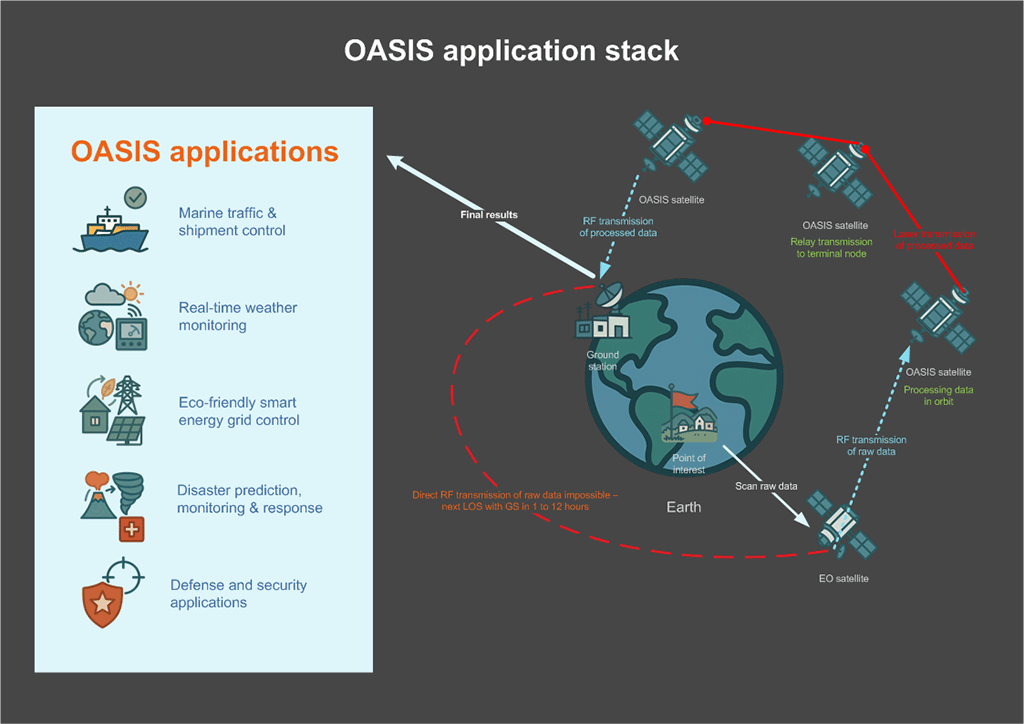
In the orbit we have a constellation of so-called ReCor (relay core) satellites, equipped with low-power universal AI chips, RF transceivers and laser links.
Commercial remote sensing satellites connects with nearest ReCor through common RF link and pass data to it same as it can pass data to ground station.
ReCor satellite processing data on its AI chips, and then beam processed data through other ReCor satellites of the constellation to one which is closest to customer ground station. This last satellite transmit data to customer via RF link.
This can be built entirely on existing tech. No new science. Just tight engineering.
Validation
But can we test the idea? Yes.
Validation was my first and urgent need during development of this startup. For this I made two separated orbital simulations, utilizing two separated approaches for modelling the constellation and measuring visibility.
Both simulations confirmed that:
- Constellation counting 192 satellite on polar LEO orbit 516 km / 97.6° able to:
- Provide constant visibility for commercial remote sensing satellites on SSO
- Provide constant visibility for ground stations on the surface
- Estimated end-to-end latency (from Earth observation satellite to customer ground station) will be reduced from 3-12 hours to 15-30 minutes.
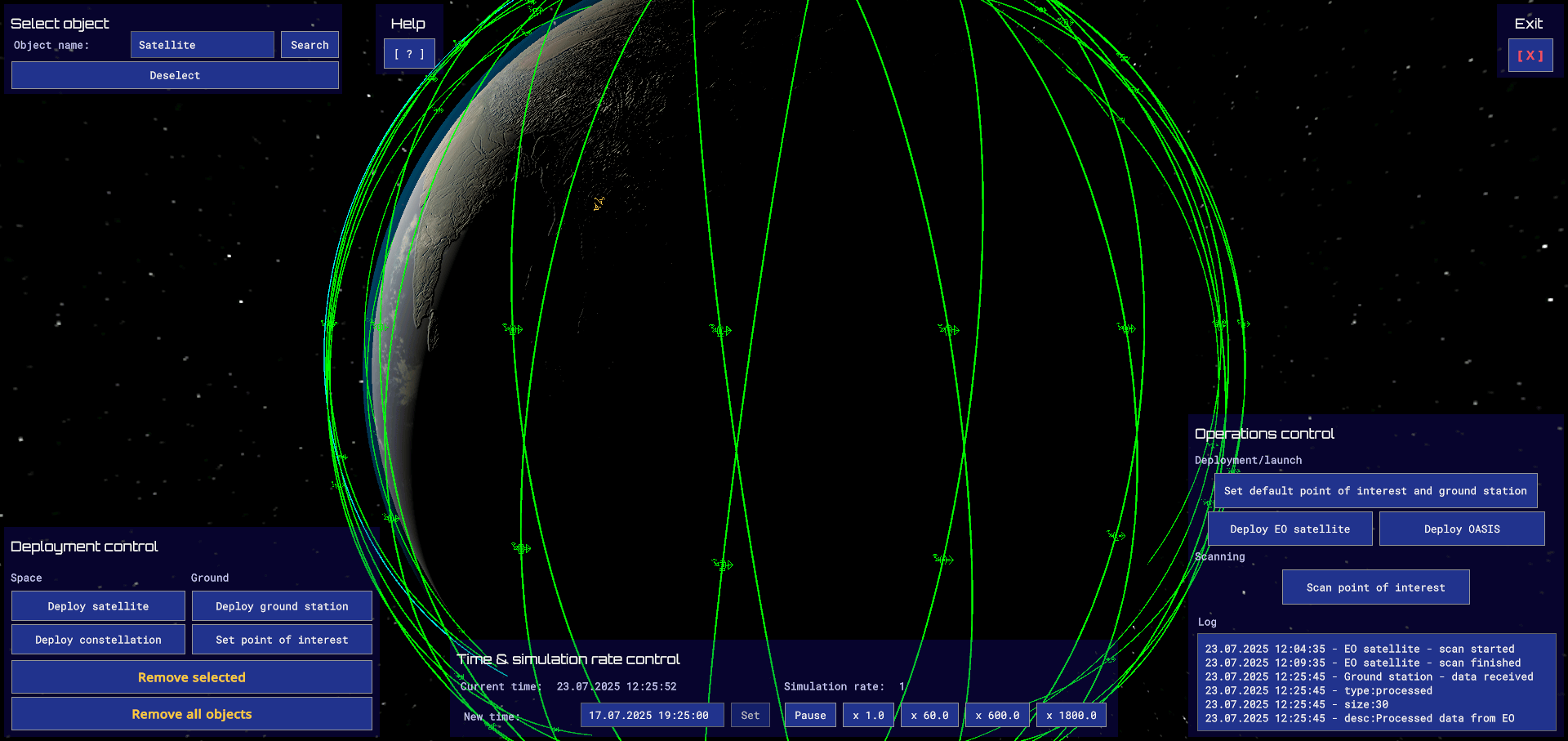
Here is the video confirming validation of the idea in Unity-based constellation simulator app:
You yourself can manually test abilities of OASIS constellation in my Unity-based WebGL OASIS simulation demo.
Open given link, then click the button “Deploy OASIS”, and then button “Scan point of interest”.
Then just watch how EO satellite will scan point of interest, transmit data to OASIS satellite and after this how processed data will beamed through the constellation to the ground station.
Time speed can be controlled with buttons in the menu “Time & simulation rate control” in the lower part of the screen.
In the log below you can see yourself the time spent for processing and transmission of satellite data.
The fate of the project
I formulated the idea of OASIS project at late June, 2025.
Till the end of July, 2025, I, together with Anna Apalkova and Rebecca W. Lee:
- Using ChatGPT AI, performed number of validations, including technical validation, marketing assessment, financial validation etc.
- Contact known investors, looking for partners.
- Built 2 separated simulations (Python-based and Unity-based) and validated the idea.
- Prepared wide range of documentation, including presentation, whitepapers, vision, monetization model, etc.
- Made wide space industry studies, looking for facilitators, who can support our project.
- Prepared and sent messages to Asian and European startup accelerators, including
But:
- Most of investment actors showed zero interest to the project.
- Small number of investors believed me… They contact me, listened to me, admired the project, said that this is a future… They supported me with very inspirational words.
When I needed money for continue work – to go from Thailand to Europe for registering our startup at ESA BIC in Switzerland – none of them provide any real support.
Seeing this I, relying on my previous experience, understood that OASIS project failed. At mid August, 2025 I stopped the project.
Conclusions
This is not a new insights. OASIS project just confirmed my old thoughts. Here they are:
- No money – no flights. Space company must have funding for at least 3 years. In other case it is doomed.
- Startups are bad for space. Hype fades fast. Promises means nothing. Space need endurance and doing real things, perfectly, in time.
- Space needs stability. Space technology and business has long cycles. Rapid scamming in chaotic changes – bad financial model for making space.