
Nice day for fishing, ain’t it?
In year 2021, I found an interesting topic about exploration of Jupiter system at on one of Russian astronomy forums. The conversation was about Europa, an icy moon of Jupiter, and especially about its structure.
The core question was about reaching subglacial ocean of Europe. In conversation users offered different ideas about ways to pass through the ice, but in all cases the solutions imply heavy machinery – drills, melting devices etc.
As an astrodynamics expert and a “space pirate” I became interested, how heavy payload we can deliver to Europe nowadays?
That’s why I plot a mission from Earth to Europa.
Goals of the project
- Assess astrodynamical possibility of flight to Jupiter system in period 2021-2026
- Roughly estimate total dv required to reach Europa
- Assess mass of payload really possible to reach Europa with modern technology
Mission details
Summary
For the launch window search boundaries I chose period from 2022 to 2024 – just because it was interesting to plot mission within closest time.
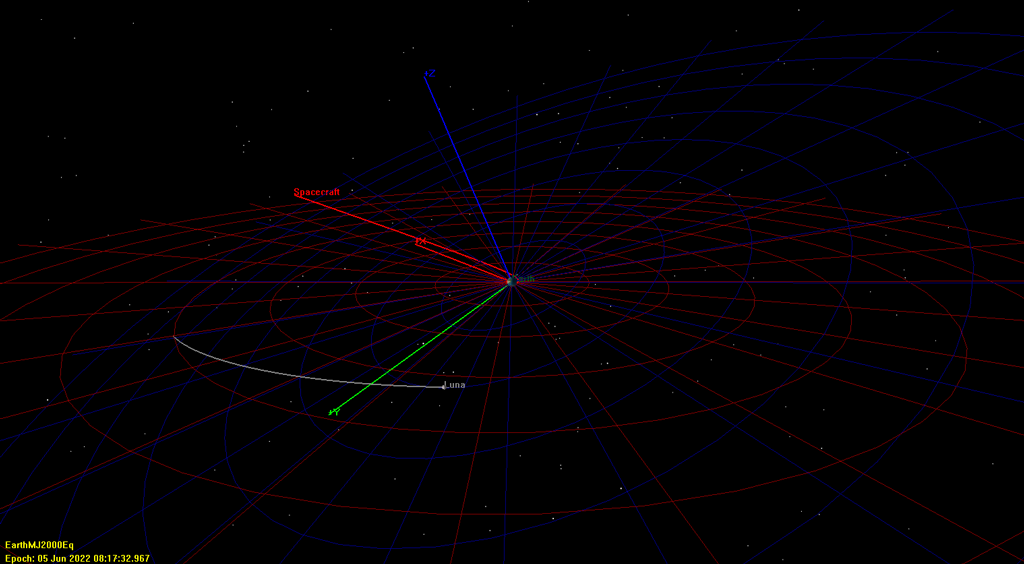
It’s well-known that nowadays alignment of planets makes reaching outer planets much more difficult than in 1970s. But this doesn’t affect access to Jovian system.
To reduce the total amount of delta-v, we should try to use gravity assists. But for launch windows within selected period there was no occasions for use gravity assist of any of inner planets.
So for Earth-Jupiter transfer was chosen Hohmann-like trajectory with number of mid-flight corrections (at positions with mean anomaly M = 45.0° and M = 90.0°).
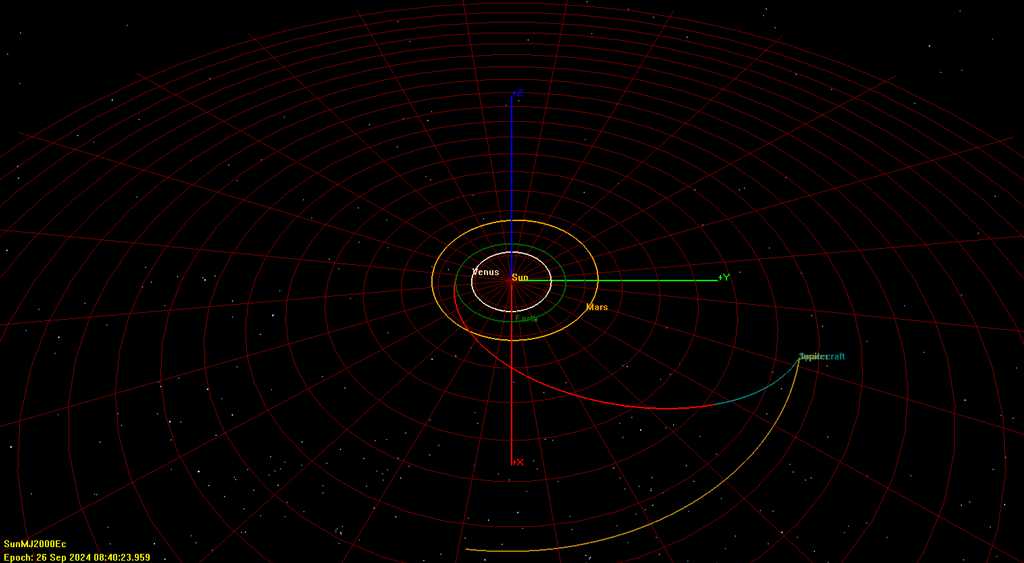
It was expected, that strong gravity field of Jupiter will require lot of delta-v. So because of this, I decide to use gravity assist of Jupiter to enter Jovian system.
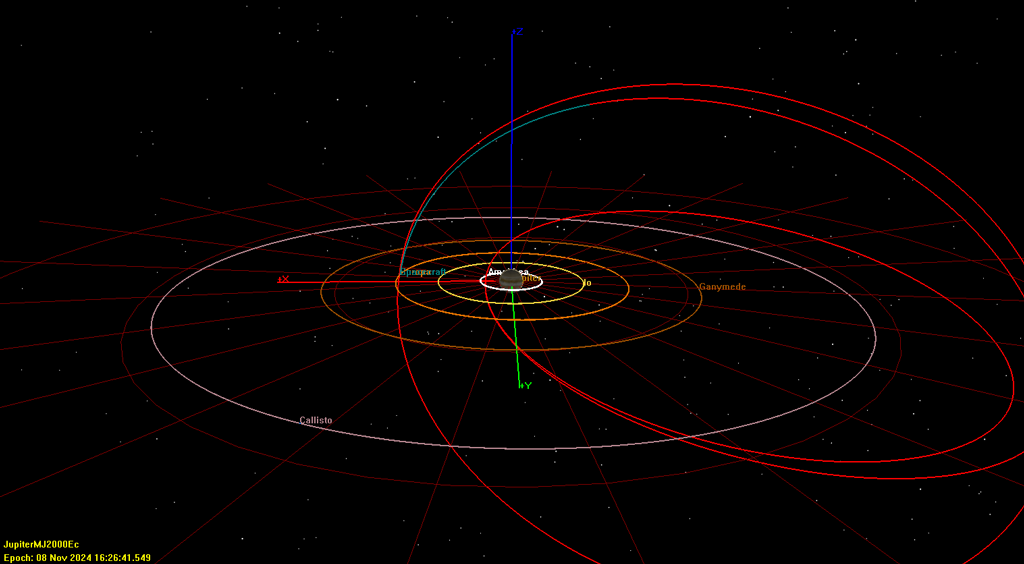
Harsh radiation in Jovian radiation belts requires limit exposition of spacecraft to this factor. So I chose for a spacecraft highly-inclined orbit with inclination i>90.0°, and tried to reduce time of flight in highly-irradiated zones.
Tools
As a tools for simulate this mission, I used:
- GMAT R2018a
- Python 3.9
Launch Window
Launch window at 2022 06 01 (June 1, 2022) was chosen with very rough algorithm based on primitive Kepler motion equations. I clearly understand that it’s incorrect for real mission, and in real case will apply porkchop plot built by total mechanical energy assess or by Lambert problem solver.
Delta-v Budget
Mission within given restrictions could be completed in 9 maneuvers.
Maneuvers was assessed as impulse burns without mass depletion simulation, because goal of the mission was estimation of delta-v budget.
Orbit Determination & GNC
Questions of orbit determination and GNC was out of scope of this project, so they were omitted.
Results
- Astrodynamic modelling of mission to Jupiter system at June 2022 proven it as possible.
- Overall delta-v budget required to reach Europa: 14.41 km/s.
- Such high required amount of delta-v strictly limiting possible payload mass.
Following Tsiolkovsky formula:
we may say that in case if (typical value for advanced MetaLOX rocket engine), mass ratio, required for reaching required speed (in case of single-stage spacecraft) would be:
Thus, mass fraction of spacecraft should be about 2%.
This is not something impossible for modern tech. Getting in count that heaviest modern launch vehicle (Falcon Heavy in fully expended configuration) can put on LEO about 63.8 tons, we can say that theoretically max payload delivered to Europa could be 1.276 ton.
Practically it is too optimistic estimation, because it does not getting in count the mass of structural elements of the rocket.
By my opinion, for “impact” mission we can talk about payload mass of tenth of kilograms (20-30 kg max).
Important Note
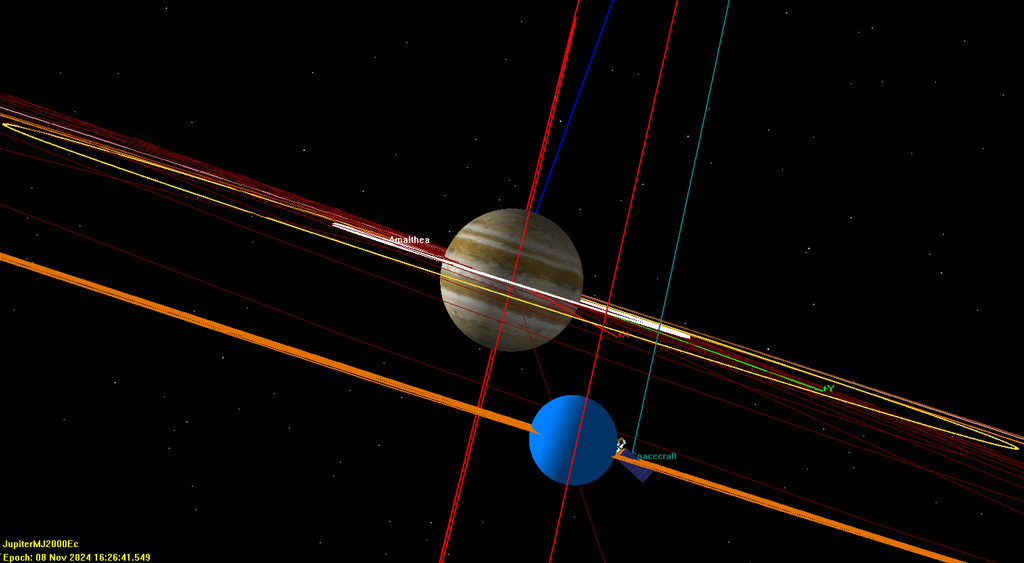
Velocity of spacecraft on approach to Europa will be roughly 21.86 km/s.
Getting in count that the goal of the mission is to reach subglacial ocean, this can be valuable. If we can find a place where ice is thinner and make impactor hard enough, this humongous velocity may help us to pierce a hole in the ice and reach the water!
So, it’s nice day for fishing, ain’t it?
Overall mission summary (physics commands) provided in attached GMAT report.