Preface
In this post I will continue my previous notes about set of autopilot apps for simulated spaceplane DeltaGlider from space flight simulator Orbiter 2016. If you need more details about design of simulator system and DeltaGlider performance, you can read it there.
Purpose
As previous simulations showed, reentry is critical stage of spaceplane mission. Also, it’s difficult to control spaceplane during reentry – you need precisely keep parameters of flight for proper aerobraking and descending, but this parameters depends on wide number of inputs, including entry angle, mass of spaceplane, distance to destination, direction of flight, drag decceleration, heat generating by air drag, etc. Parameters itself also non-linearly changing in wide range. Control of spaceplane is bulky (as I mentioned, its aerodynamics reminds one of a slightly smoothed brick). In addition, reentry process takes from 30 to 50 minutes.
To say shortly – it’s very easy to make a mistake on reentry. And this mistake can make whole mission failed. This was inappropriate.
So I decided to automatize the control of reentry process.
Principle
Reentry supposes smooth reduce of speed from to and altitude from 120 km to approx. 20 km.
Deceleration appears due to air drag force. Spaceplane, moving through air of atmosphere, pushing masses of air gas molecules aside. Doing this, spaceplane spending its kinetic energy and transmitting it to pushed molecules. Because speed (and, through this, kinetic energy) of spaceplane is extremely huge, fraction of energy transmitted to gas is also big. This energy heating the gas at the area of its contact with moving spaceplane. Gas re-emitting this heat back on the hull of spaceplane, heating it. This heat can weaken and damage the structure of spaceplane.
Additionally, deceleration can be too fast, especially in dense layers of atmosphere. This can cause high overloads, which is bad – high-Gs can damage the spaceplane and even kill the crew.
But we have no other powers to reduce our humongous speed except the air drag force!
So we must reduce spaceplane speed utilizing air drag force, but we must avoid situation when this drag force is too high and able to destroy us.
Approach
For deceleration of DeltaGlider we obviously can not use same approach as for blunt body reentry capsules (like Soyuz, Apollo or Dragon spacecrafts).
We should follow approach typical for really existed spaceplanes – like Space Shuttle or Buran. But here lays number of troubles.
First one – there is no publications with detailed description of algorithms of control during reentry of Shuttle or Buran. Or, better to say, there is publications, but the algorithm descriptions there are vague and incomplete. This is understandable – mechanics of reentry and hypersonic gliding in upper atmosphere is typically an interest of military, and works about it typically top-secret.
Second – DeltaGlider has pretty different design and flight characteristics than Shuttle or Buran. Especially:
- It is much lighter (~12 t. vs 70+ t.)
- It is protected from heat in a different way (if Shuttle and Buran was covered with ceramic tiles, then DeltaGlider is skin is made with integration of niobium–titanium superalloy elements in most heated places)
- Tests in simulation showed that it has different hypersonic aerodynamics:
- it can not do aerobraking “bottom forward” because can’t keep this orientation turned by airflow
- it easily collapses from overheat and overload in case of deep dive
- but it is much more optimized for hypersonic gliding in upper atmosphere
So it became obvious we have very different machine, which is more like North American X-15 or Boeing X-20 Dyna-Soar, than like Shuttle or Buran.
From this, I understood that we should develop our own approach, using information about Shuttle and Buran “more like guidelines that the rules”…
Chosen way
From available publications, for example from “Atmospheric Re-Entry” by John C. Adams, Jr. and form data from Buran.ru site I knew, that:
- US Space Shuttle on reentry followed pre-calculated (with methods of optimal control) so-called “equilibrium glide trajectory”, keeping very specific entry angle and angle of attack (changing in time)
- Soviet Buran did almost same, but it had more advanced guidance system, allowed to calculate further trajectory till the very end of reentry “right on the fly”. This made Buran more agile than Shuttle in navigation sense. But in general principle was close to one used on Shuttle.
After number of tests, I noticed that DeltaGlider typically decelerates with highest rate at altitudes from 55 to 35 km altitude, with peak deceleration at about 42.5 km. Same time, it developed lot of lift, allowed it to climb – i.e., it literally glided there, in scattered air of upper atmosphere. This lift tended to push spaceplane away from the atmosphere into a series of extreme long “ricochets” (much longer than those described for Shuttle and Buran) when descending trajectory of spaceplane drastically elongated.
Taking these observations into account I decided to combine Soviet and US approaches – dynamically control gliding of DeltaGlider within the dynamically changing interval of optimal deceleration altitude, controlling deceleration rate (and through this, reentry exit point) with changing the altitude.
Method
Warning!
From the very beginning I must note that this algorithm is a very primitive try to control reentry of fictional spacecraft in relatively simple simulation system. You should not try to apply it for real reentry control without full-pledged scientific founding and full-scale testing.
Initial conditions
Before the reentry spaceplane must keep “parking” orbit with apoapsis radius km and periapsis radius km, coplanar within tolerance with position vector of reentry exit point.
At this orbit at great circle distance from 16 to 18 Mm, a reentry insertion burn impulse must be provided. This impulse must set . This trajectory will create proper flight path angle .
Then operator should await till altitude will decrease to 120 km. Approximately at this altitude, Reentry AP should be activated.
Modes
Reentry AP automatically switches between 3 modes:
- Entry
- Aerobraking
- Descent
Entry is an initial phase of reentry. During it spaceplane keeps zero lift pitch and prograde orientation to ensure smooth entry into atmosphere with minor thermal stress and overload.
Aerobraking is the main phase of decceleration process.
Descent is a final phase of the flight, when spaceplane keeps heading and altitude after reducing flight speed to required.
We will not describe entry and descent phases because they are relatively obvious, and focus on aerobraking phase.
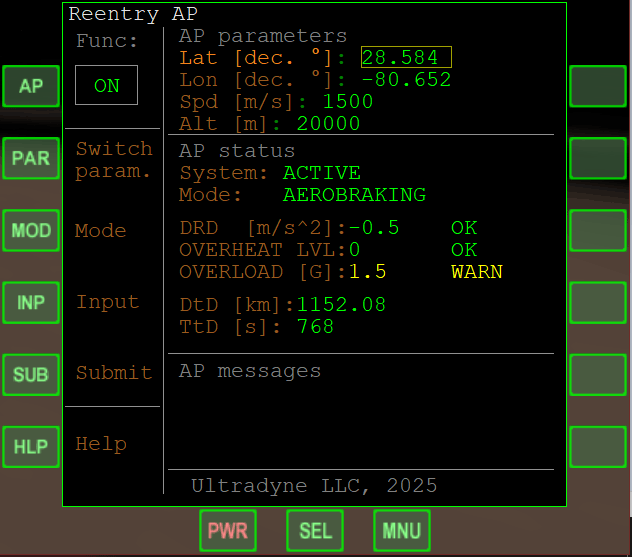
Aerobraking
Aerobraking phase starting when flight altitude falls lower than 70 km and speed is still higher than required for final descent.
By sense, purpose of aerobraking can be expressed as:
where – time, – absolute position, – velocity,
– control (generated by autopilot), – deviations (effects of air drag etc.) – relative position (read – distance from reentry exit position), and
In simple words – to reach destination from reentry entry point, we must at each point of our flight apply to our spaceplane such a control , which in sum with state (inertia) and deviations will deliver spaceplane to destination state .
This control, as expected, depends mostly on velocity vector at given relative position .
Control generation algorithm is sophisticated. At development, I understood that I need somehow predict behavior of DeltaGlider, in a way as it was done in Buran landing autopilot algorithms. But this solution seemed too computation-intensive. That’s why I tried to use simplified solution (maybe that was not the best idea).
So, algorithm gathered current state:
Then, it calculates required acceleration:
This calculation is complex but important, so here I’ll provide full formulation:
Please don’t ask me what is ! 😅 I can not answer. This solution was developed by trial-and-error, and just worked.
Further, calculating indirectly, through calculation required altitude and application of it through control of elevator. This approach is required because we control by changing the altitude of glide. So required altitude will be:
Here and are altitude and acceleration power factors, is overheat offset, is altitude offset and is simulation step.
We applying required altitude through:
Here is glide slope angle, and is change of elevator control surface angle.
Self-criticism
Described solution surely far from optimal or elegant. Now, after a time passed since work on this control, I clearly understand that it could be implemented in more clean and simple way.
The reasons of such bulky approach was in sophisticated control methods of hypersonic flight and complex constraints. Also, I was slightly disoriented by the logic from previously implemented Atmospheric AP.
The way of optimization of this algorithm is in implementation of rigorous model of relation of deceleration from . This will allow to get rid of strange coefficients, and follow the logic stated in initial integral formulation of aerobraking in more clear way.
Autopilot diagram.
Autopilot C4 diagram is attached to this post.
As you can see, by structure Reentry AP does not differs much from Atmospheric AP. The key differences are focused in controller container.
Same as in Atmospheric AP the system able to work in two main modes – Execute and Standby. But, on Execute system runs through selection of control mode, and passes control to one of three control modes mentioned earlier. On each step of execution controller uses code from Trajectory, Overload and Overheat calculation components.
After generating control on execution, system controls not only aerodynamic surfaces, but also RCS and airbrakes.
Results
The development of Reentry AP required about 3 weeks of work.
Same as with Atmospheric AP, I can not yet assess stability of control generated by this autopilot mathematically.
Multiple tests and practical application during simulated space mission showed that with keeping of initial conditions, Reentry AP provides steady control on all reentry stages and guide DeltaGlider to given exit points coordinates reliably and safely.