
Preface
As I mentioned in my previous notes, expertise in astrodynamics and navigation requires practice. So, because of this, I undertook a try to simulate a space mission.
Goals
Planned simulation had next goals:
- Practical testing of algorithms for calculation an orbital maneuvers, provided in a book “Fundamentals of Astrodynamics and Applications“, Fourth Edition, by David Vallado.
- Gathering practical experience of planning of space missions to LEO
- Gathering practical experience of orbital maneuvering
- Development a skills of work with complex technical systems in conditions of stress, lack of data and limited time
Implementation
As space flight simulation app was chosen space simulator Orbiter 2016 developed by Martin Schweiger – because it is the only space simulator, providing industrial-grade simulation precision.
As mission planning software was used GMAT R2020a and self-made Python algorithms, based on materials provided by D. Vallado in “Fundamentals” mentioned above.
During preparation for simulation I faced number of very complex technical problems, which was solved only after complex studies of simulator architecture and development of number of C# GNC apps and LUA-based inter-process communication interfaces.
Mission
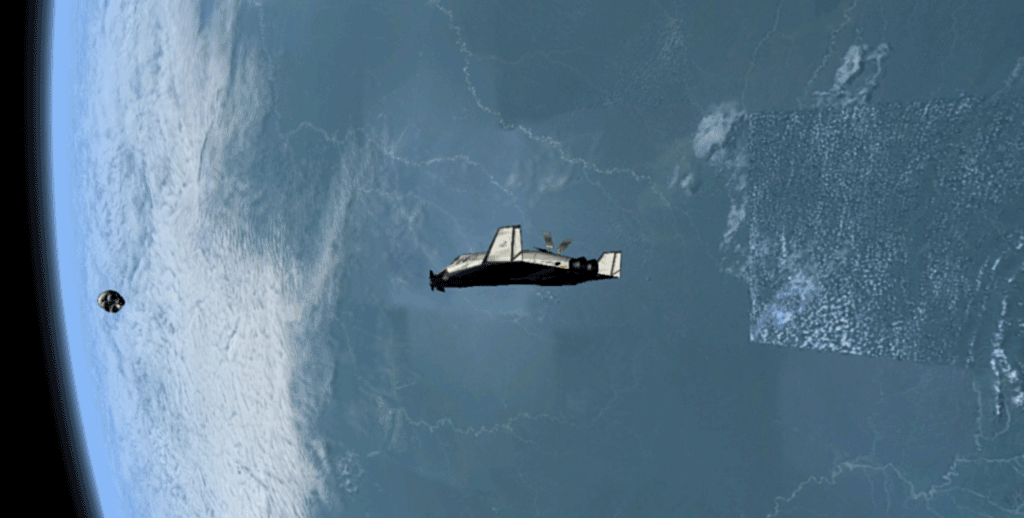
The goal of the mission was a rendezvous of fictional crewed spaceplane DeltaGlider1 (created on the base of designs of spaceplanes developed in late 1980s – early 1990s) with optical remote sensing satellite Formosat-5 (faced unknown software failure in 2017), for a service and repair.
DeltaGlider will be launched form high-latitude launch site near St.Petersburg with fictional launch vehicle based on US “Titan” launch vehicle family.
Because launch vehicle is slightly underpowered for such heavy payload, the DeltaGlider had require to gain part of orbital speed with its own engines, and then be refueled in orbit. For this purpose it had to make a rendezvous with two previously launched RAMU (Refueling Autonomously Managed Unit).
Mission name – “Rendezvous with RAMU” – was developed from two things – first, from Arthur C. Clarke “Rendezvous with Rama” sci-fi novel, where human explorers intercepted the alien spaceship; and second, from our favorite soda “Ramune” in metal bottles, appeared in Japanese shops in St.Petersburg at late 2021. Analogy of intercept in space big cylindrical fuel tanker, and of “refresh” from it like drinking soda from Ramune bottle, inspired the name of the mission.
Special rules
Same as during Circumpolar flight simulation, to achieve goals of simulation, additional rules was formulated. Main rules were:
- Provide detailed modelling of all operations required for mission – including mission design and whole flights of all spacecrafts involved in mission
- Use save/load mechanisms of simulator only:
- for protection from external treats (“crashes” of simulator, power failures, etc.)
- for pause mission during work or rest time (planned length of mission was from 3 to 8 days)
- In case of critical mistake, which could not be fixed utilizing resources of private space company performed this mission, mission should be threatened as failed
- In case of unplanned landing in a wild area, crew of the mission must walk on foot distance between actual landing point to nearest settlement
Results
Mission appeared to be not so successful as I expected.
Mission plan was good. Orbital maneuvering was not extremely precise, but successful. Simulation of service operations caused troubles, but we found alternative solution and finished the work. But my reentry autopilot software contained errors, which caused critical situation during reentry. Because of this, I had to land DeltaGlider at non-planned place (Jack. F. Paulus Skiway at Amundsen-Scott Antarctic station). So, I can say that mission was partially successful – but only because of luck.
You can read detailed report about this mission (in Russian) in a file, attached to this post.
- Important to note, that Original DeltaGlider provided in Orbiter 2016 distributive was equipped with thrusters with unrealistic s. To achieve realistic flight performance in simulation, spaceplane thruster parameters were changed. Actual parameters presented in mission report. Since this post, any further mentions of DeltaGlider always implies this “modified” version of the spacecraft, until different will be posted explicitly. ↩︎