Debriefing
At May 12, 2025, I, Daniil Galakhov, together with my friends Anna Apalkova and Rebecca W. Lee performed full-fledged real-time simulation of space mission to intercept defunct super-heavy remote sensing satellite ESA “Envisat” (NORAD ID: 27386) and install on it Drift Augmentation Device (DAD) to deorbit it.
Launch was scheduled at May 12, 2025 07:39:22.8 UTC.
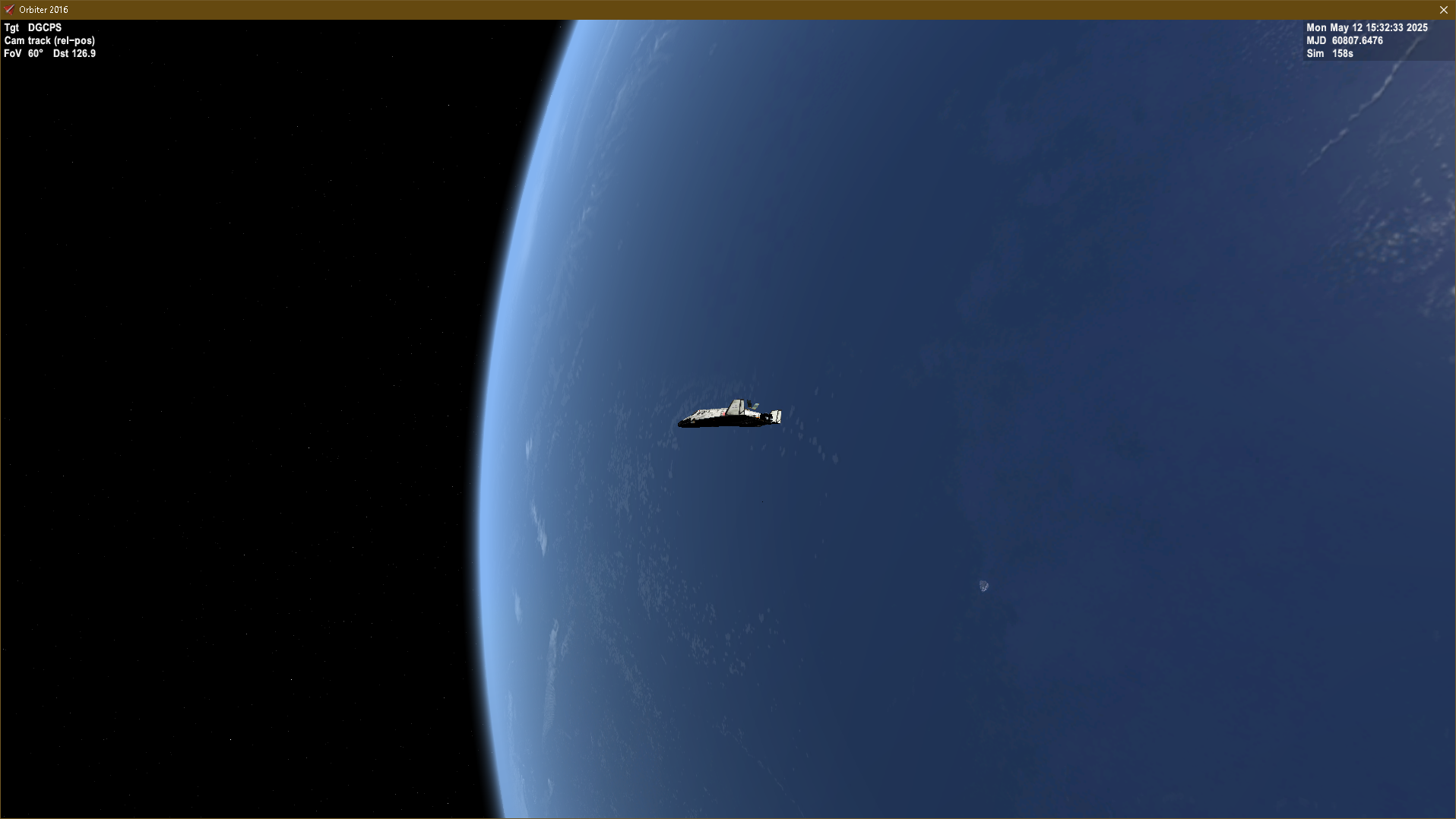
After launch from (fictional) space launch site SRC Polyigon on Sumatra island in Indonesia on “Energia” launch vehicle & (fictional) DeltaGlider1 spaceplane we performed intercept and rendezvous with “Envisat”.
After 40 minutes of EVA DAD was deployed on Envisat.
Then, after completion of series of maneuvers, DeltaGlider reentered atmosphere and safely landed on runway of SRC Polygon after 12 hours and 5 minutes of flight.
Mission was completed successfully.
Despite minor malfunctions in flight control software, all mission objectives were completed successfully.
Mission planning software worked nominal.
All vehicle systems worked nominal.
No equipment damage detected.
All crew safe, health conditions normal.
Simulation software worked nominal.
Purpose of simulation
After my previous attempt of simulation of space mission and participation in real space mission I made a number of conclusions:
- Studying astrodynamics, you must have practical application.
- Only real flight or very high grade real-time simulation can be used as “practical application”, because work of astrodynamicist during space flight suppose time- and information-constrained conditions.
- Flight in space and orbital maneuvers can be performed manually or with simple orientation-keeping “autopilot”. But for effective and precise maneuvering advanced autopilot required.
- Space mission is not limited by “one Hohmann transfer”. It includes all stages – from launch to reentry and landing. Only successfully completed mission is really successful. For proper practical application, simulation must include all stages of the mission.
- Real space mission includes not only flight itself, but wide range of preparations, technical and other (legal, organizational, etc.). To be a good astrogator, you need to have knowledge about this activities.
From this conclusion developed the purpose of new simulation:
- Simulate full space mission, implementing realistic scenario and conditions (environmental, technical, organizational, legal, etc.)
- In this simulation, study methods of safe and precise space and atmospheric flight and maneuvering using fictional, but technologically realistic spaceplane.
- To do this, implement all required software (autopilots, subsystems and add-ons for simulation, external mission design software, etc.), and use simulation to test correctness of used solutions.
- Study and implement all additional elements possibly required in real space mission (flight plans, RF schedules, EVA work / safety protocols, mission planning documents, legal information, etc.)
With this ideas, we started a development of a new simulation.
Why Envisat?
When we began planning our orbital test mission back in early 2025, we had a question: what should we fly to?
We weren’t building a game. We were building an advanced spaceflight simulation, implementing as much realism as possible for private study. So we needed not “just” a target, but something worth doing.
We were confused what to chose. So we asked ChatGPT to generate ideas, to give us objects in orbit with high public recognition – especially those celebrating an anniversary in March or April 2025. The answer came back with several candidates. Second in list was it – Envisat. It was big. It was hard to reach. It was dangerous. It was real – and it could become the source of a cascade of orbital collisions if left uncontrolled.
So we set out to simulate something that could, one day, help to solve that. I can say that we chose Envisat for the same reason JFK described going to the Moon:
“Not because it is easy, but because it is hard.”
John F. Kennedy
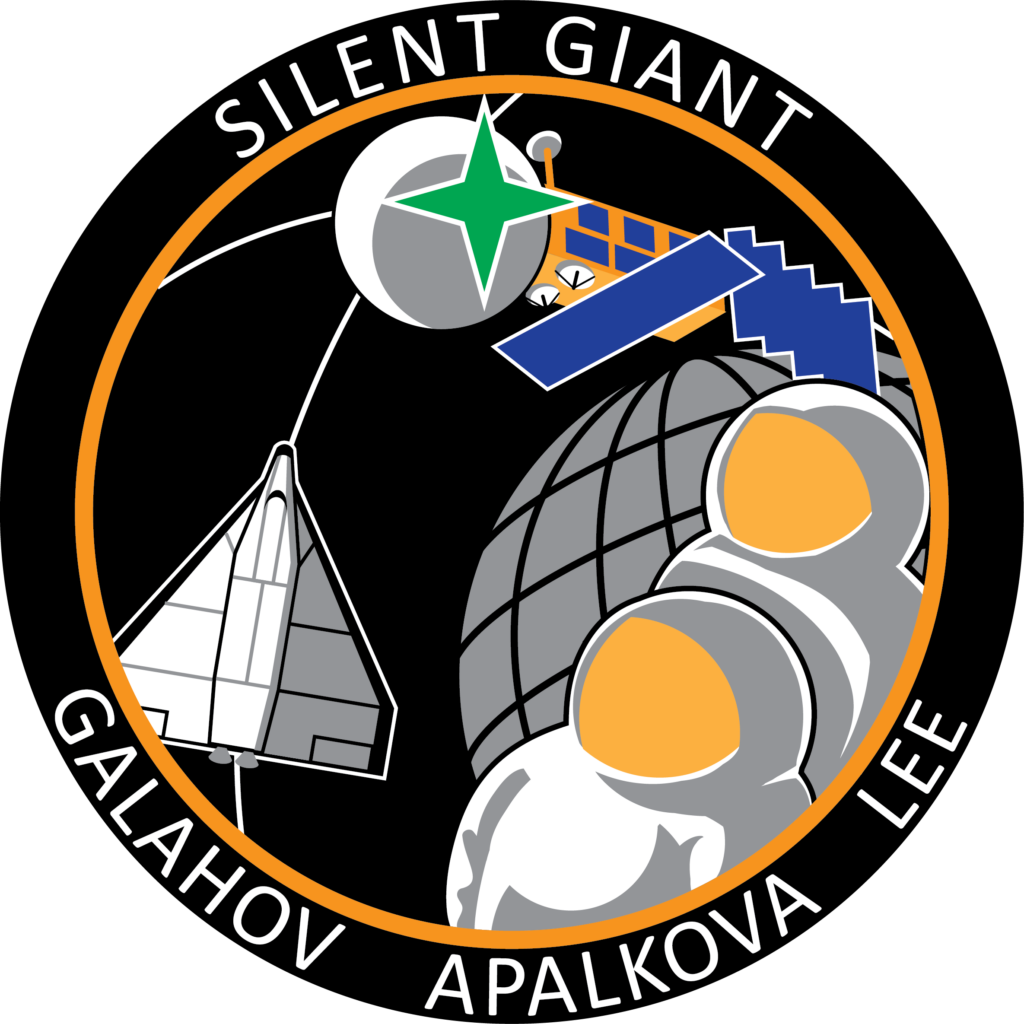
We called this mission Operation “Silent Giant”.
Preparations
Preparations for simulation required almost 4 months (not including development of codebase I had after my studies of astrodynamics and previous simulations, volunteering and work).
During this time I:
- Improved atmospheric and reentry autopilots for DeltaGlider.
- Developed full-fledged orbital autopilot for DeltaGlider, allowed:
- Automatically calculate and plan complex orbital maneuvers, (including orbit changes, transfers, intercepts and rendezvous) using highly optimized “Two-Stage Zoom” targeting algorithm, achieved calculation timings:
- for time-constrained Lambert transfer – 0.03 sec.
- for delta-v optimized Lambert transfer – 0.23 sec.
- Automatically complete planned, fully three-dimensional maneuvers, achieving spacecraft aiming precision 0.05° and burn execution precision 0.01 m/s.
- Complete automatic station-keeping during transfer arcs using 6 DoF PID-based algorithm, allowing to keep deviation of position and velocity of spacecraft within given boundaries.
- Automatically calculate and plan complex orbital maneuvers, (including orbit changes, transfers, intercepts and rendezvous) using highly optimized “Two-Stage Zoom” targeting algorithm, achieved calculation timings:
- Developed mission, allowing to complete rendezvous with Envisat within given time and delta-v constraints.
During this work I relied on knowledge and algorithms from “Fundamentals of Astrodynamics and Applications”, Fourth Edition, by David Vallado. Mr. Vallado kindly helped me with some complex questions about mathematical expression of spacecraft attitude. I deeply grateful to him for this guidance.
Together with my colleagues Anna and Rebecca, we:
- Completed studies about legal questions of space debris operations.
- Completed Envisat engineering analysis, including structure and design studies and assessment of hazardous chemicals contamination.
- Completed Envisat motion analysis.
- Completed Envisat deorbiting risk assessment.
- Developed deorbiting method for Envisat (including design, mechancs, basic modelling of efficiency of Drift Augmentation Device and development of its add-on for Orbiter 2016 simulator).
- Completed EVA planning including:
- Safety rules
- Developed attachment methods to get a grip on Envisat
- Developed EVA operations plan.
During this process, we got useful help from:
- Aleksandr Khokhlov – Head of Small Spacecraft Projects at Geoscan Group. He multiple times helped us with consultations and educational examples.
- Christophe Bonnal – IAA Chairman of the Space Debris Committee, CNES Senior Expert, topmost expert in space debris. He provided to us important feedback about assessment of risks of deorbiting super-heavy satellites.
Additionally, as I need to mention help from generative artificial intelligence chatbot ChatGPT. He many times helped us with intellectual data search and initial data analysis. Usage of him as co-programmer allowed me to reduce total development time costs about 30%.
Simulation.
Simulation was completed in May, 12 2025, in full real-time, without stops except short pauses after two crashes of Orbiter 2016 simulator.
Full simulation, including pre-launch procedures, required 12 hours 45 minutes of real time.
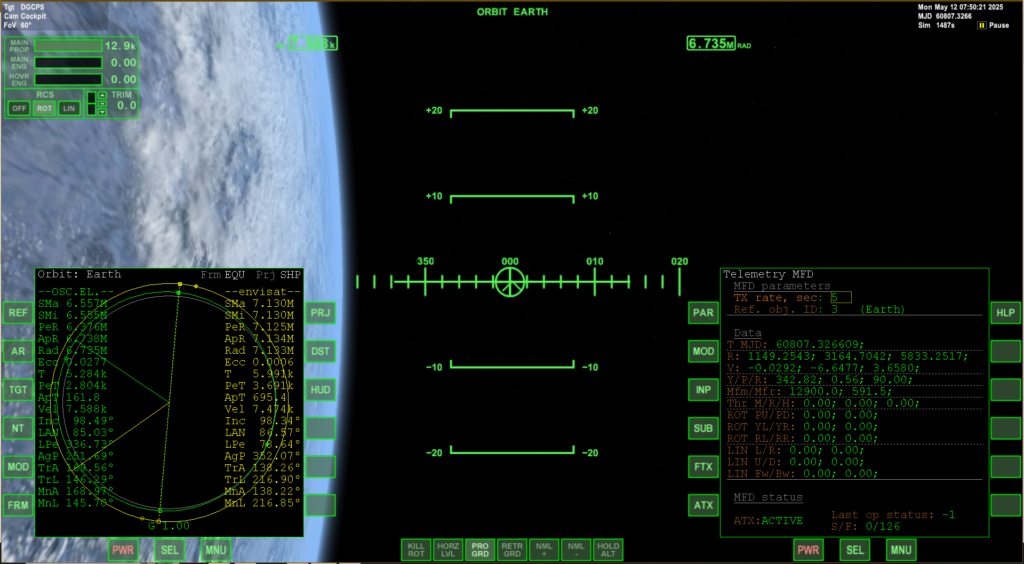
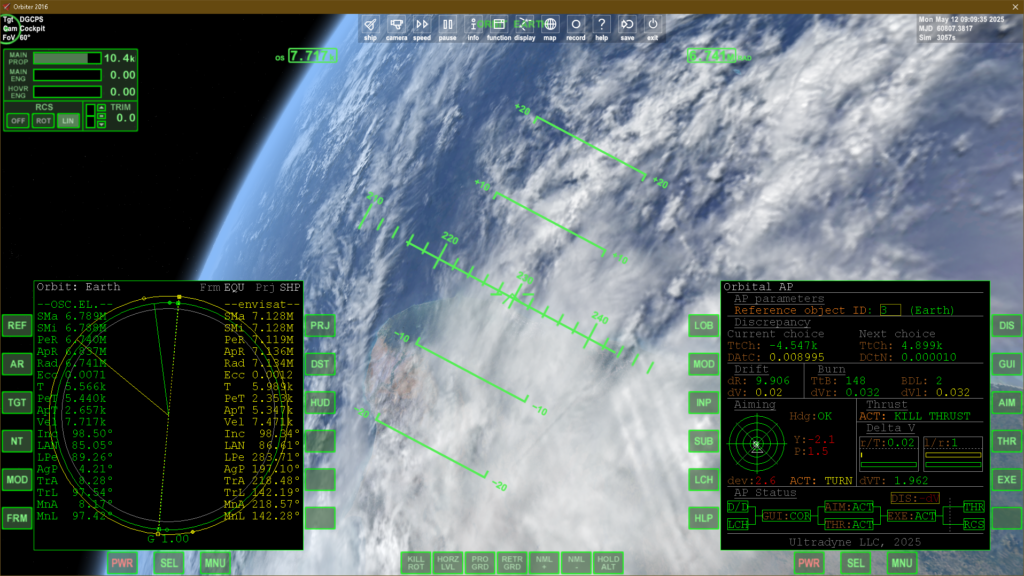
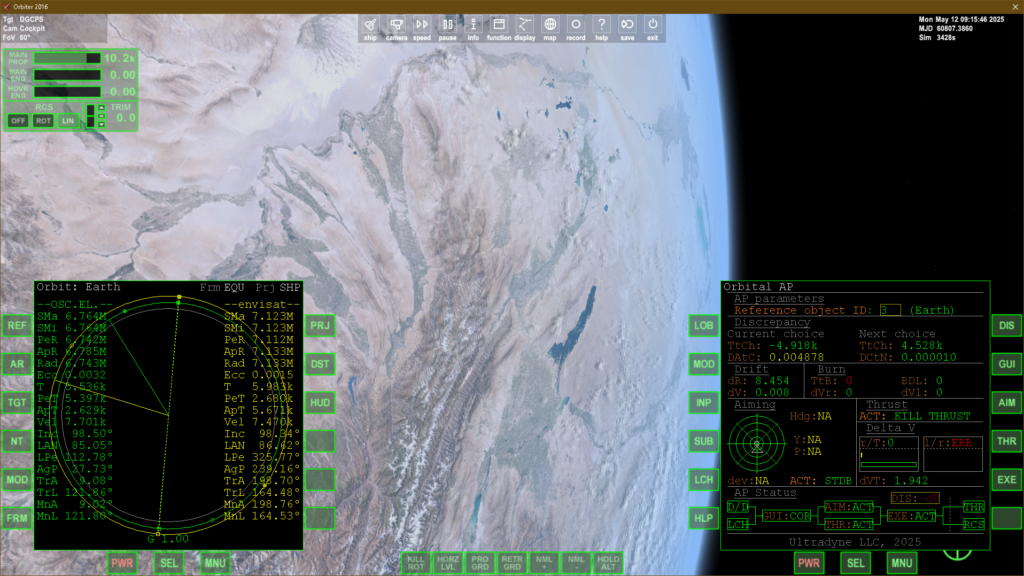
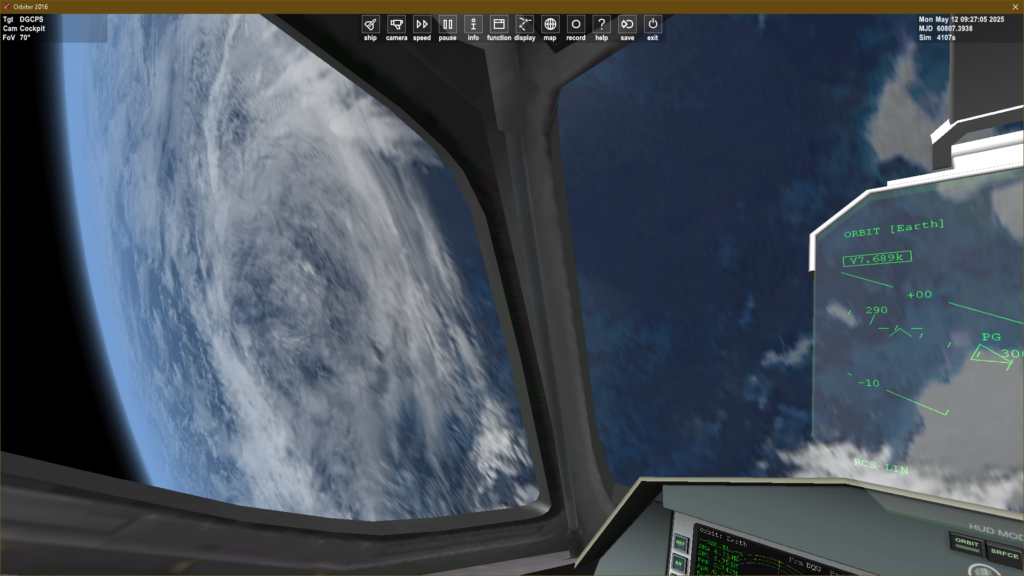
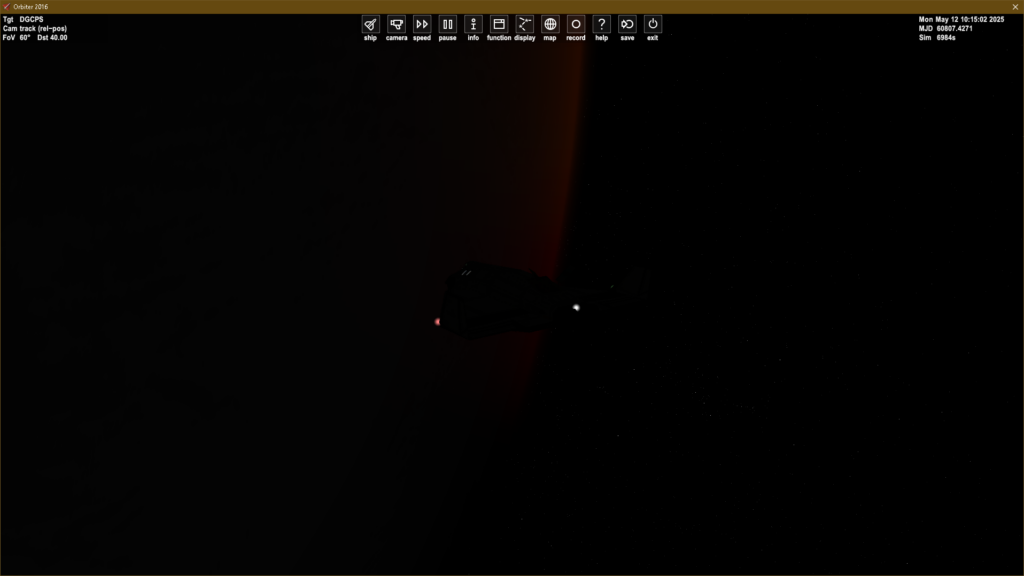
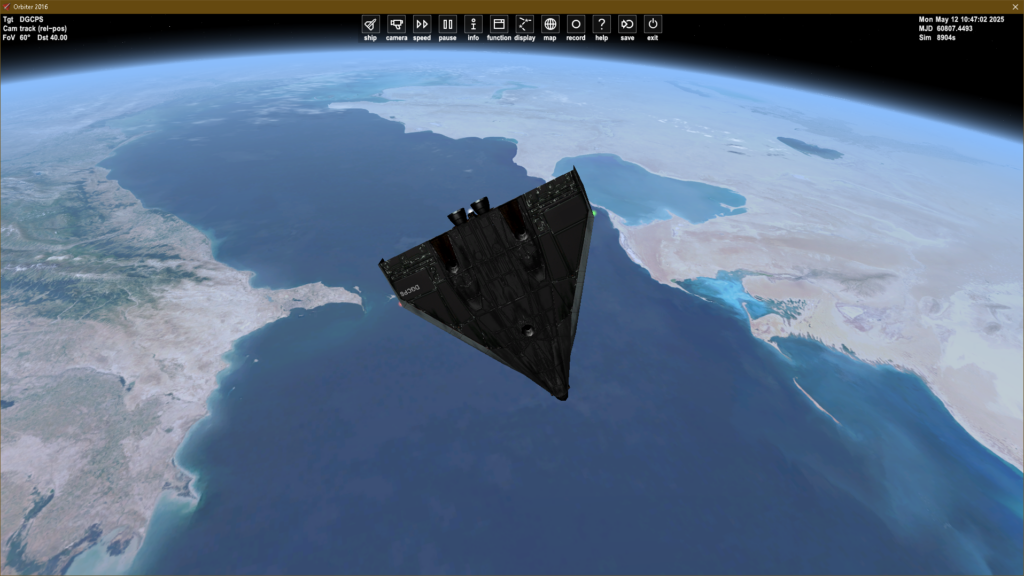
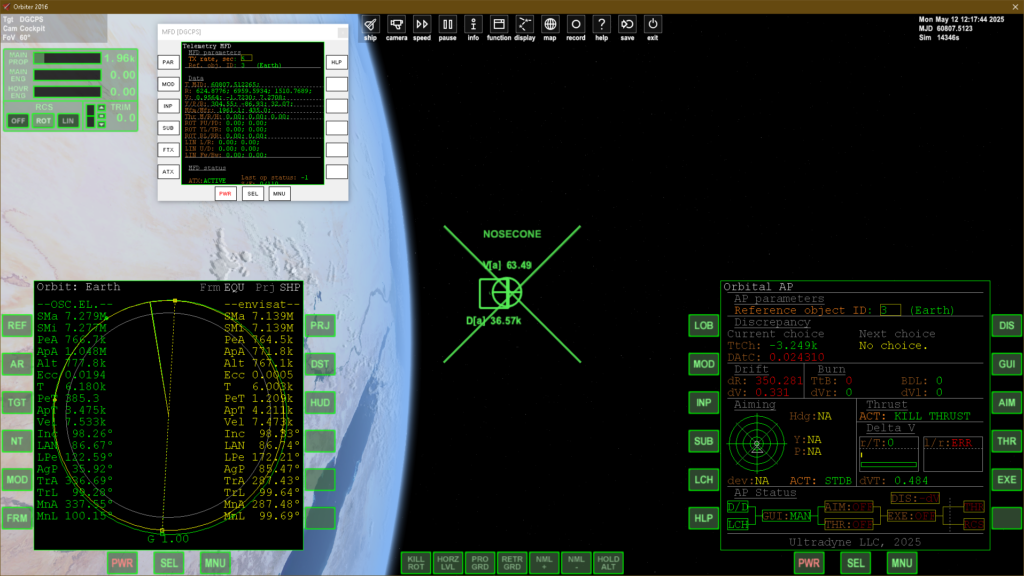
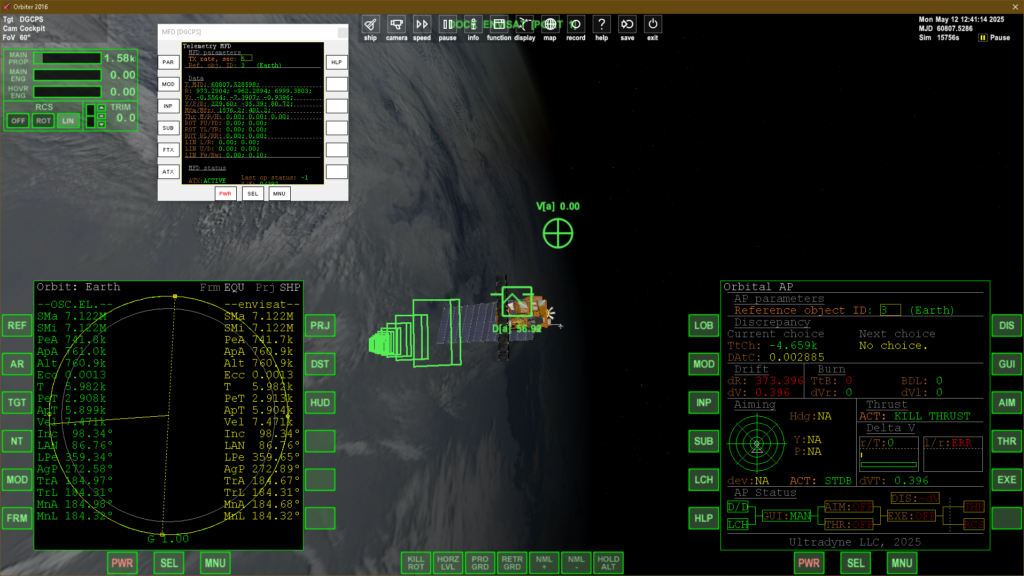
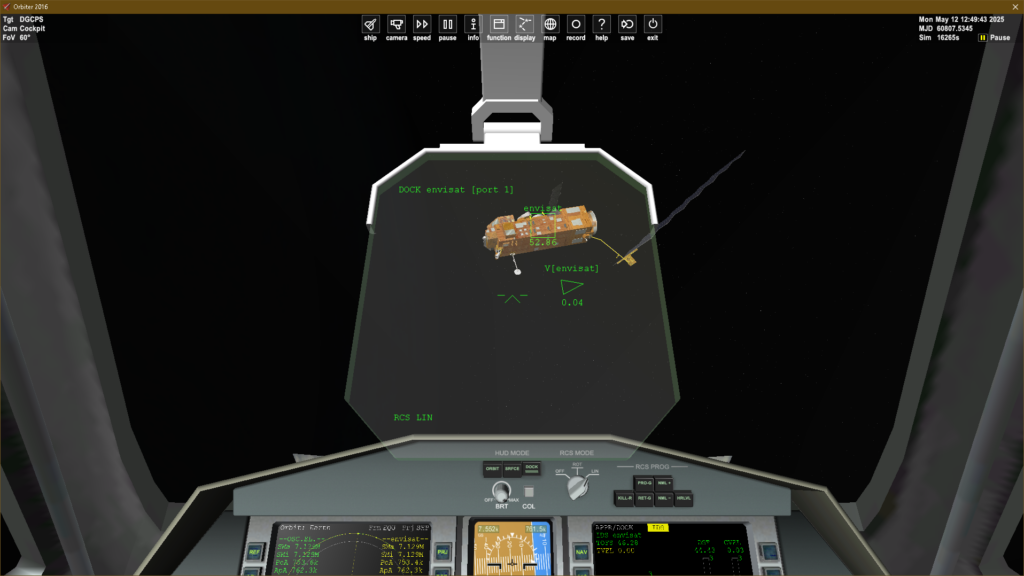
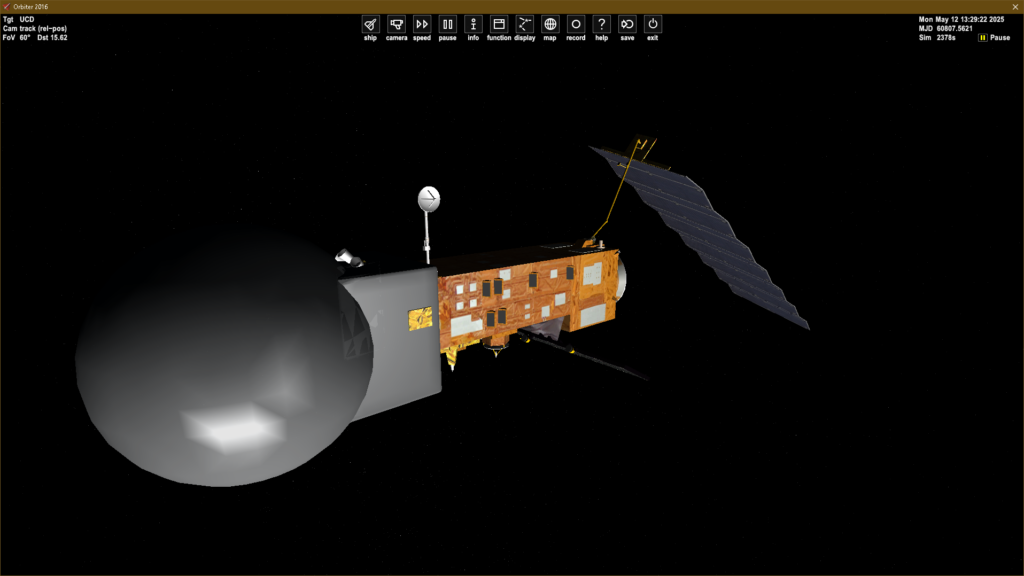
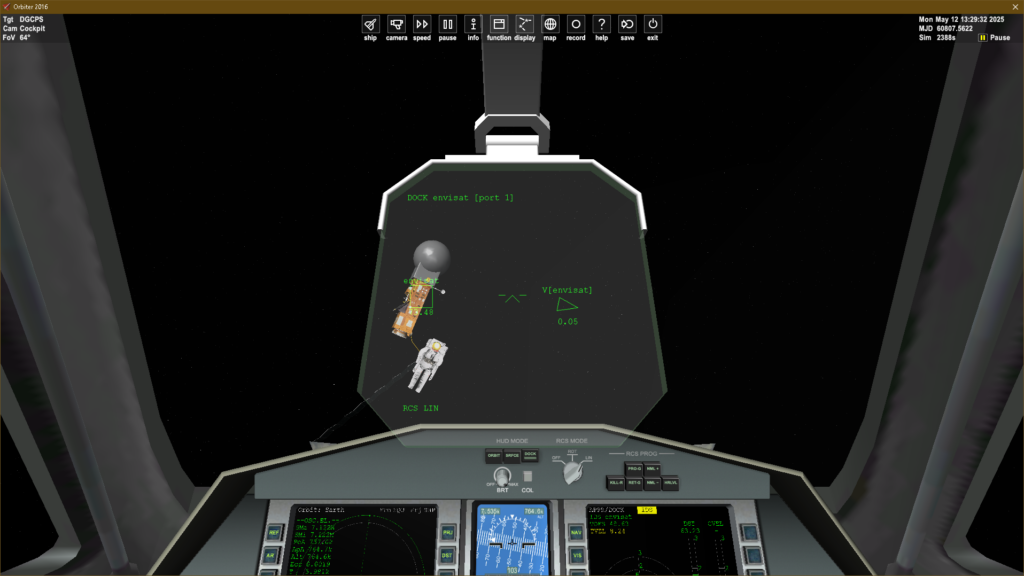
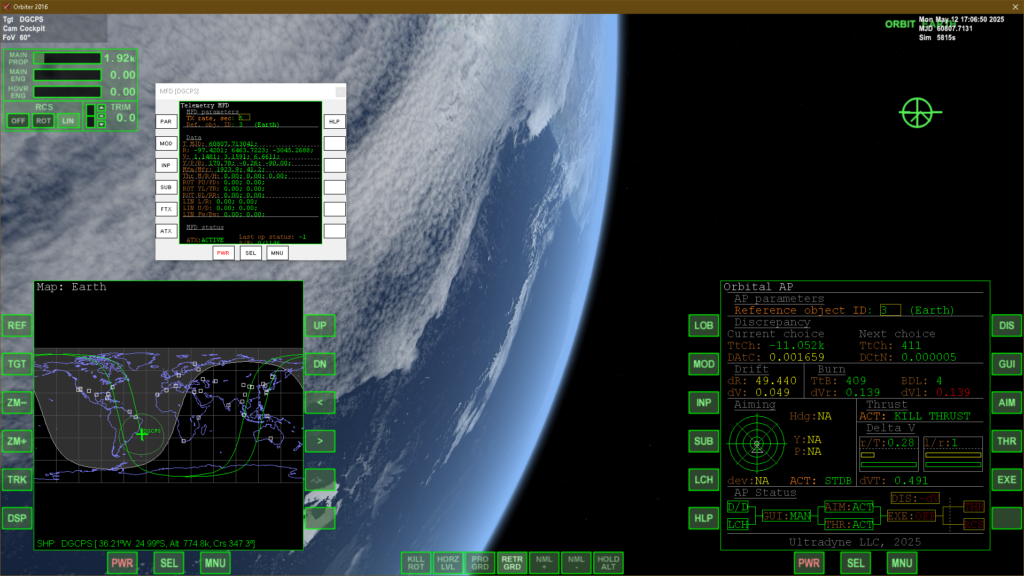
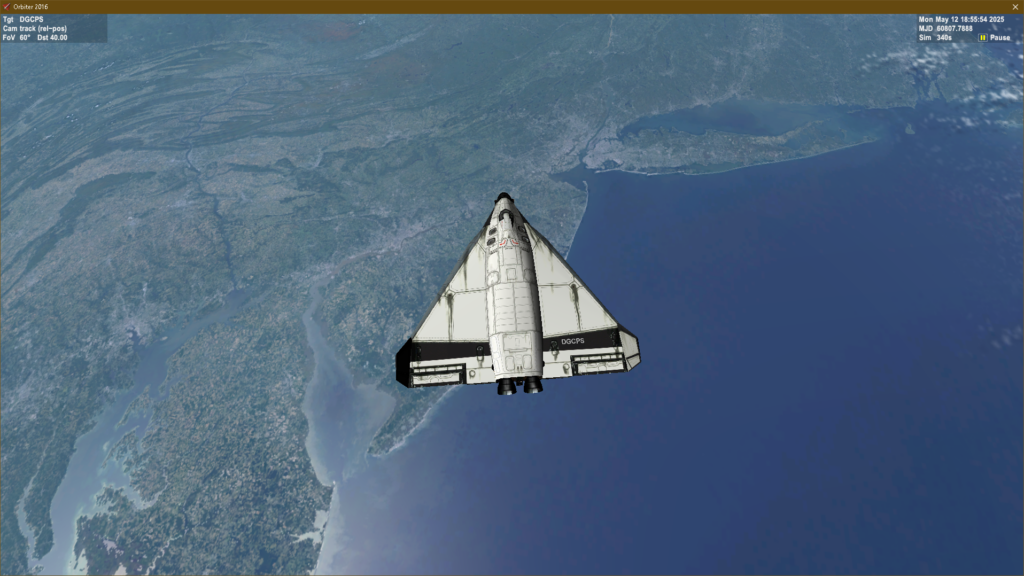
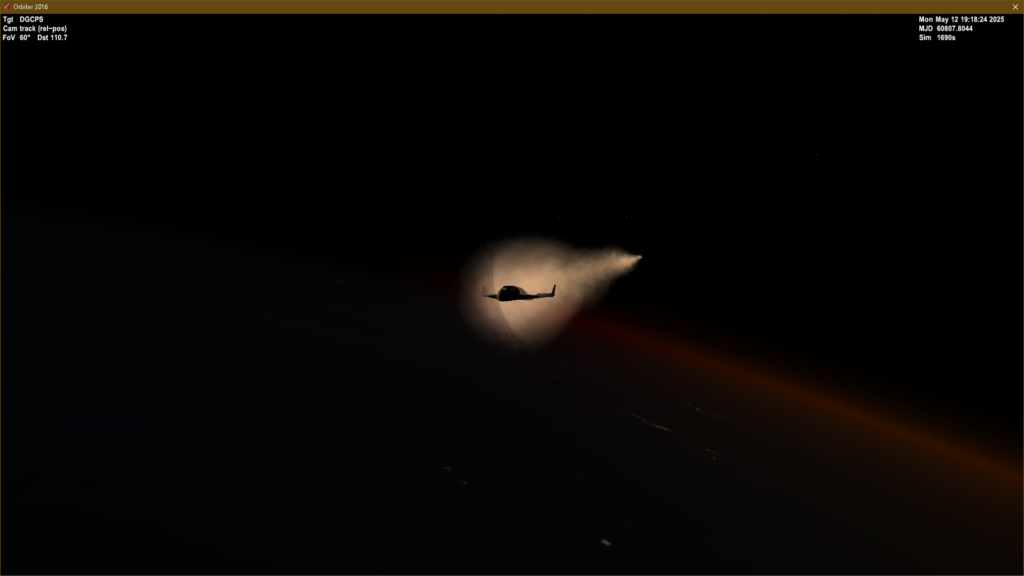
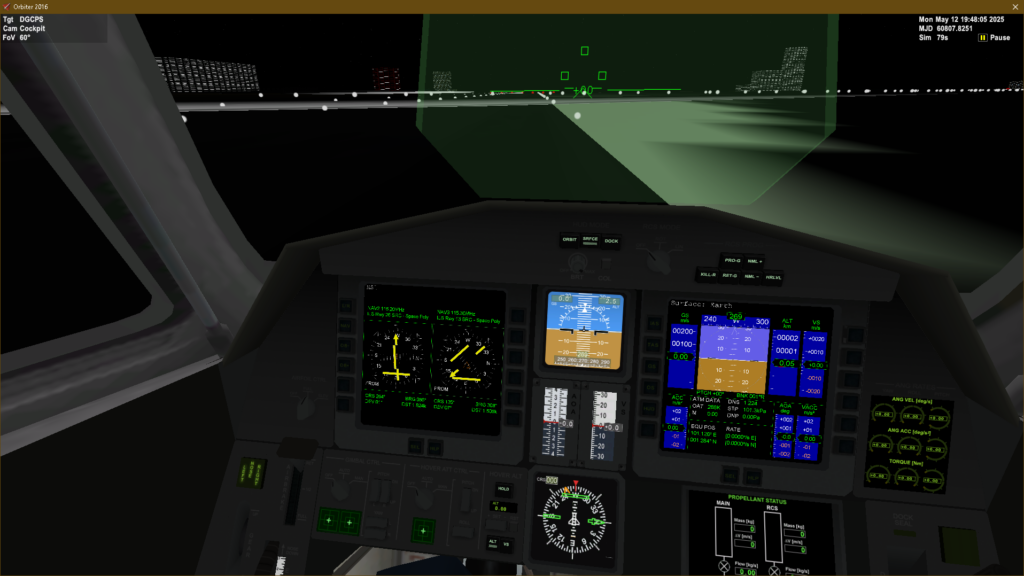
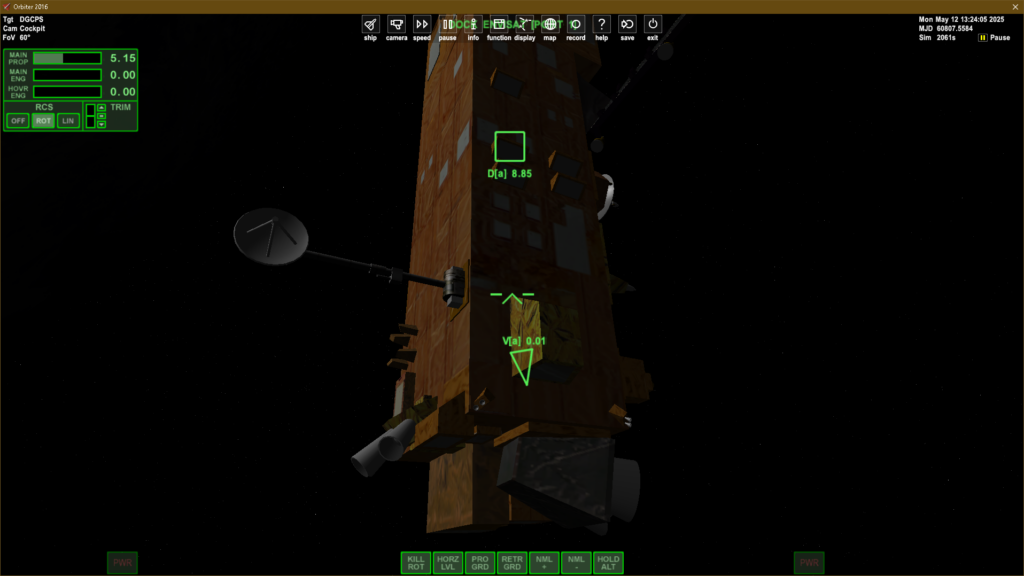
Here is a gallery of screenshots captured during simulation:
Report
Full mission report you can download here:
- Original DeltaGlider provided in Orbiter 2016 distributive was equipped with thrusters with unrealistic s. To achieve realistic flight performance in simulation, spaceplane thruster parameters were changed. Actual parameters presented in mission report (p. 12). Since this post, any further mentions of DeltaGlider always implies this “modified” version of the spacecraft (“DeltaGlider CPS” – with Chemical Propulsion System), until different will be mentioned explicitly. ↩︎